

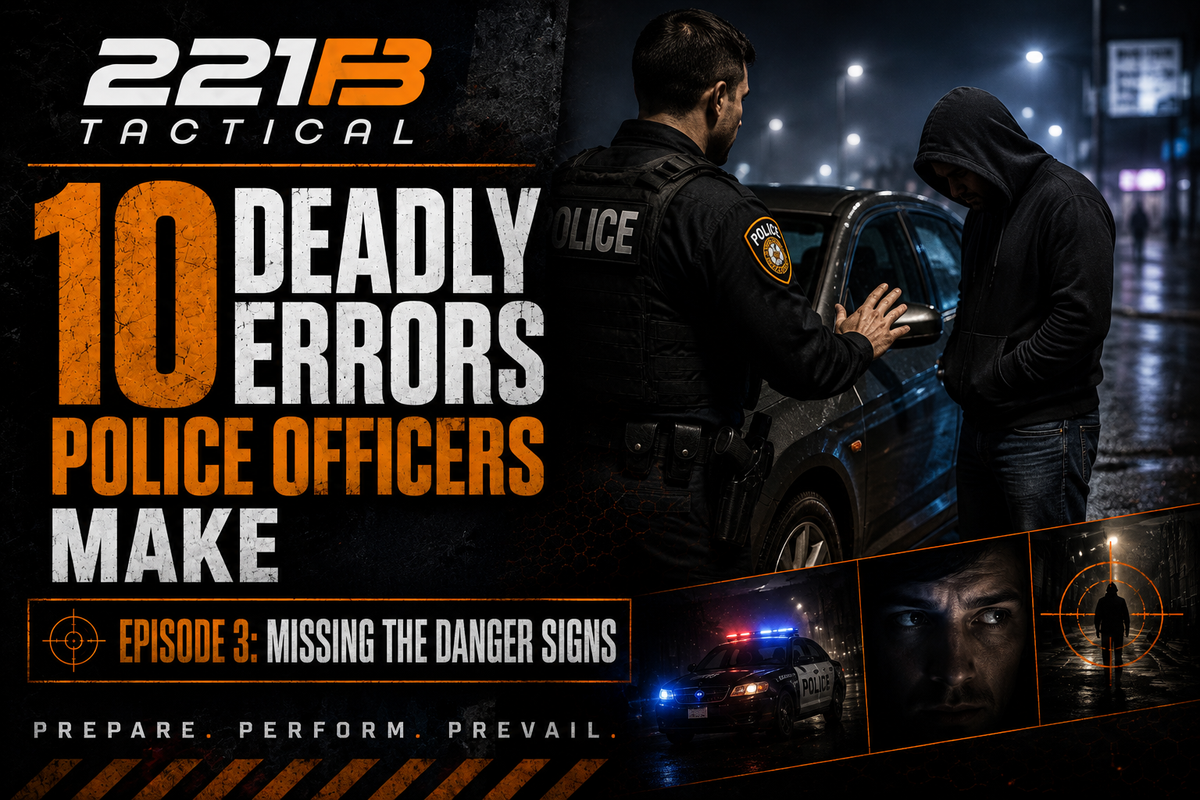
There is usually a warning.
A look. A movement. A change in tone. A hand that disappears. A person who suddenly stops talking. A passenger who keeps looking around. A call that just doesn’t feel right.
Most deadly encounters don’t begin with a giant flashing sign that says, “THIS IS ABOUT TO GO BAD.” They start with small clues. Sometimes those clues only last a second. Sometimes they are so subtle that you can’t even explain exactly what bothered you.
But something did.
And that is where officers get into trouble.
We see something. We feel something. We know something is off. Then we talk ourselves out of it.
“Probably nothing.”
“He seems cool.”
“She’s just nervous.”
“I’m overthinking it.”
“I’ve handled calls like this a thousand times.”
That kind of thinking can get you killed.
The Signs Were There
After a police officer is seriously hurt or killed, the incident gets picked apart.
Body camera footage gets watched frame by frame. Dispatch audio gets replayed. Witness statements get taken. Reports get written. Supervisors, trainers and investigators look at everything that happened before the attack.
And many times, you can see it.
The danger signs were there.
The suspect kept touching his waistband. Someone inside the house was acting strangely. A driver wouldn’t show both hands. A person kept looking toward an exit. Someone who was yelling suddenly became very calm. A suspect kept asking questions about what the officer was going to do next.
None of those things automatically means someone is about to attack you.
That matters.
Good police work is not about treating everyone like a criminal. It is not about being paranoid. It is about noticing behavior and being willing to respond when several things start telling you that something isn’t right.
You don’t need to panic.
You need to pay attention.
Your Brain Is Picking Up More Than You Think
Have you ever walked into a room and immediately felt like something was wrong?
Nobody said anything. Nothing obvious happened. But something changed inside you.
That feeling isn’t magic.
Your brain is constantly taking in information. Body language. Facial expressions. Movement. Distance. Hands. Voice. Eye contact. The way people are standing. The way they are looking at you. The way they are looking at each other.
Sometimes your brain recognizes a pattern before you can explain it with words.
That is why I believe officers need to respect that little voice that says, “Something isn’t right.”
That doesn’t mean you draw your weapon every time somebody makes you uncomfortable. It means you become more alert. You create space. You improve your position. You watch the hands. You slow things down if you can. You get another unit coming.
You start preparing for what could happen next.
Because once the attack starts, your options shrink fast.
Watch The Hands
If you spent any time working the street, you’ve probably heard this a thousand times.
Watch the hands.
There is a reason.
Hands hurt you.
Hands grab weapons. Hands throw punches. Hands reach under seats. Hands open doors. Hands grab officers. Hands reach into waistbands and pockets.
Yet officers still get distracted.
We look at faces. We look at driver’s licenses. We look at computer screens. We look at passengers. We look at paperwork. We get pulled into conversations.
Meanwhile, the hands start moving.
This doesn’t mean staring at somebody’s hands every second. It means knowing where they are and recognizing when their movement doesn’t make sense.
If you tell someone to keep their hands visible and they keep reaching toward their waistband, that matters.
If you ask someone to step out of a vehicle and they suddenly reach under the seat, that matters.
If somebody keeps trying to put one side of their body away from you, that matters.
One sign may mean nothing.
Several signs together should get your attention.
Listen For Changes
Danger signs aren’t always physical.
Listen to people.
A person’s voice can tell you a lot. Someone who has been screaming for ten minutes and suddenly becomes calm deserves your attention. Someone who was answering every question and suddenly stops talking deserves your attention.
So does someone who starts asking unusual questions.
“Am I going to jail?”
“Are you going to search me?”
“Is another officer coming?”
“What happens if I don’t cooperate?”
Again, none of those questions automatically means an attack is coming.
But your job is not to judge one clue by itself. Your job is to take in the whole picture.
Behavior.
Hands.
Words.
Environment.
Distance.
Position.
Other people nearby.
Put the pieces together.
Don’t Let Normal Become Safe
One of the biggest problems in police work is that dangerous situations often look normal right up until they aren’t.
You’ve made hundreds of traffic stops.
You’ve answered hundreds of domestics.
You’ve dealt with drunk people. Angry people. Mentally unstable people. People with warrants. People who hate cops. People who lie straight to your face.
And most of those encounters end without anyone trying to kill you.
That’s exactly what makes this dangerous.
Repetition can teach your brain that because something has been safe 999 times, it will probably be safe the 1,000th time.
Maybe it will.
Maybe it won’t.
The call doesn’t care how many times you’ve done it before.
The person standing in front of you doesn’t care that you’re two hours from the end of your shift.
The weapon under the seat doesn’t care that this looks like a routine traffic stop.
There is no such thing as a routine call when another human being gets to decide what happens next.
Don’t Explain Away What You’re Seeing
This is where experience can sometimes work against you.
Experienced officers are good at reading people. But experience can also make us very good at explaining things away.
“He’s nervous because he’s being stopped.”
“She’s looking around because she’s scared.”
“He probably didn’t hear my command.”
“He keeps reaching because he’s drunk.”
Maybe.
But what if you’re wrong?
You don’t have to assume the worst about everyone. You also don’t have to ignore what your eyes are telling you just because you want the situation to stay calm.
There is a difference between being aggressive and being prepared.
There is a difference between paranoia and awareness.
Professionals understand that difference.
Give Yourself Options
Recognizing danger early buys you something incredibly valuable.
Time.
Time gives you options.
Maybe you create more distance.
Maybe you change your position.
Maybe you move away from the doorway.
Maybe you stop standing directly in front of the vehicle.
Maybe you wait for backup before going hands-on.
Maybe you move a bystander out of the area.
Maybe you stop talking for a second and actually look at what is happening around you.
Small changes made early can completely change what happens next.
The goal isn’t to predict the future.
The goal is to avoid being surprised by it.
Complacency Makes You Blind
You know what makes danger signs harder to see?
Comfort.
You’re tired. You’re hungry. Your shift is almost over. Dispatch has been hammering you with calls all night. Your report queue is backed up. You’ve got court in the morning. You’re thinking about something happening at home.
You’re physically on the call.
But mentally?
You’re somewhere else.
That’s when things get missed.
This is why being Mission Ready is not just about fitness, shooting, tactics or having the right gear.
It’s about discipline.
It is the discipline to treat the next call like it matters, even when the last hundred didn’t turn violent.
Because the bad guy gets a vote.
And he doesn’t care that you’re tired.
If It Feels Wrong, Pay Attention
One of the biggest lessons I learned during my 13 years as a police officer was simple:
Don’t ignore the feeling.
You don’t have to understand it immediately.
You don’t have to explain it.
You don’t have to prove it to anybody.
Just pay attention.
Look around.
Where are the hands?
Where is your cover?
Where is your partner?
Who else is nearby?
Where are the exits?
What changed?
What are you missing?
Those few seconds of awareness might be the difference between recognizing the attack before it starts and trying to catch up after it has already begun.
And in a violent encounter, catching up is a terrible place to be.
Mission Ready Means Seeing It Before It Happens
At 221B Tactical, we talk constantly about being Mission Ready.
That phrase isn’t marketing bullshit to me.
I spent 13 years wearing a badge. I know what it feels like to walk into situations where you have incomplete information and no idea what is waiting on the other side of the door.
That’s why I built 221B Tactical.
Our gear is designed to solve problems and help you perform when things get uncomfortable. But gear is only one part of the system.
Your body has to be ready.
Your equipment has to be ready.
And your mind has to be ready.
You can’t control everything that happens on the street. You can’t control the suspect. You can’t control the call. You can’t control when somebody decides to turn a normal interaction into a fight for your life.
But you can control your preparation.
You can control your awareness.
You can control whether you listen when your training, experience and instincts are telling you that something isn’t right.
See the signs. Trust the signs. Act before you lose the opportunity.
Stay alert. Stay disciplined. Stay Mission Ready.
Eliminate The Impossible.
— Suresh Madhavan
Suresh Madhavan is the Founder and CEO of 221B Tactical. Raised by a single immigrant mother, he learned the value of discipline, resilience, and hard work at an early age. Initially pursuing a career in medicine, the events of 9/11 changed his path and led him to serve his community as a police officer.
During his time in law enforcement, Suresh saw firsthand the lack of innovative, purpose-built gear available to first responders. What began as a solution built in his garage became 221B Tactical—a brand dedicated to equipping professionals with gear they can trust when it matters most, while promoting a lifestyle built around one standard: staying Mission Ready.
After 13 years of decorated service, Suresh took early retirement to build 221B Tactical full time. Since 2003, he has founded and exited three companies while building a commercial real estate portfolio across multiple states.
Outside of business, Suresh applies the same standards to his own life. He is a Brazilian Jiu-Jitsu Brown Belt, strength trains, competes in HYROX, runs ultramarathons, trains for Ironman triathlons, and works daily with his Belgian Malinois.
Whether in business, training, or life, his philosophy remains the same: prepare relentlessly, stay Mission Ready, and Eliminate The Impossible.
Request your discount code
Email our Customer Care team with your department and role. Verification takes minutes, and the code never expires.

Have a question about this discount?
Send an enquiry and it goes straight to our sales team at support@221btactical.com — not a public comment. Required fields are marked with an asterisk.